
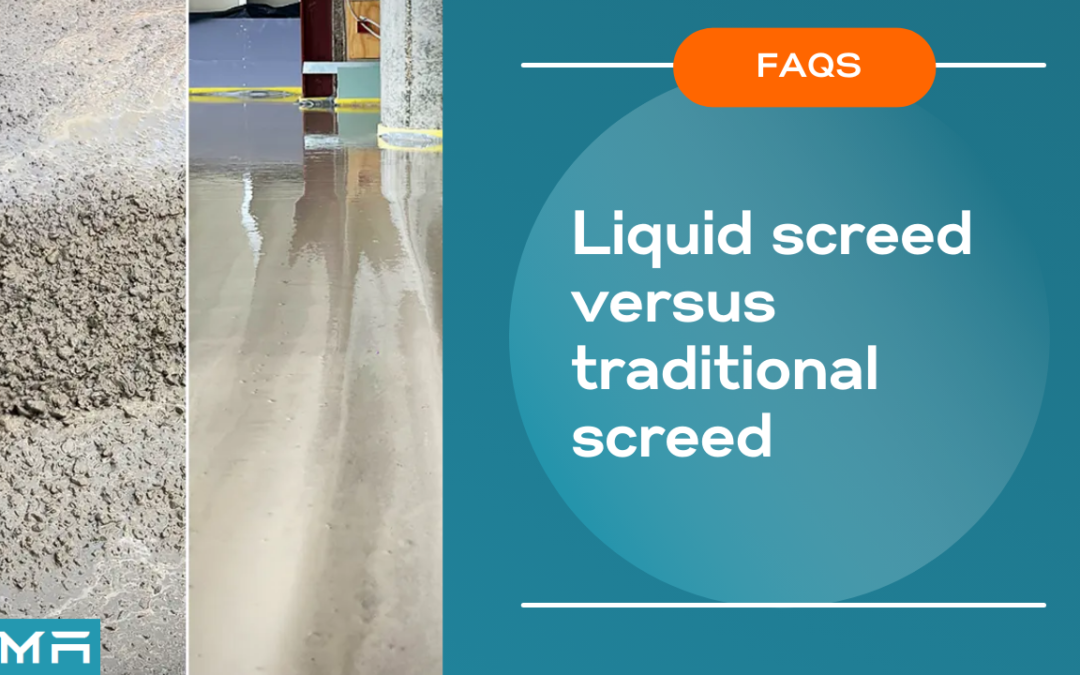
In London’s fast-paced construction and renovation market, choosing the right floor screed matters. Traditional sand-and-cement screed has been used for decades, but liquid (flowing) screed offers modern advantages. At LMA Floorscreeding, with 15+ years’ experience across London and the South East, we help homeowners and contractors choose the best option for their project.
What’s the difference?
Liquid screed (often calcium sulphate/anhydrite) arrives pre-mixed and is pumped into place. It flows freely, self-levels, and needs minimal trowelling. Traditional screed is a semi-dry mix of cement and sharp sand (typically 1:3–5) laid by hand in sections, compacted and trowelled to a finish. This hands-on method allows installers to form slopes and “falls” for drainage (wet rooms, showers, balconies, ramps). Traditional screed is usually covered to cure and dries slowly (often around 1mm per day).
Key comparisons
- Speed & labour: Liquid is pumped quickly over large areas (thousands of m²/day). Traditional is slower and more labour-intensive, but works well in smaller rooms or restricted access.
- Thickness: Liquid can be thinner (35–40mm) than traditional (50–65mm) yet still very strong, reducing floor load—useful in multi-storey London buildings.
- Drying time: Traditional dries roughly 1 day per mm up to 50mm (BS8203), so 75mm can take 75–100 days. Liquid is often walkable in 24–48 hours and ready for floor finishes in 7–21 days (some fast-drying systems can be finished in about a week).
- Underfloor heating: Liquid fully encases UFH pipes, improving heat transfer; studies suggest it can be up to 100% more efficient than sand/cement.
- Cracking & finish: Liquid typically shrinks less; traditional can crack if not cured/reinforced. Liquid may need laitance removal before floor coverings.
- Cost: Typical UK ranges are £11–14/m² traditional vs £12–16/m² liquid; time savings can offset costs on bigger pours.
- Moisture: Anhydrite liquid is moisture-sensitive unless sealed; both usually need correct damp-proof measures.
Alternative: LMA also installs cementitious self-levelling screeds (e.g., Cemfloor), combining flow with better suitability in wetter areas.
Which should you choose? Liquid suits large open-plan floors, fast-track programmes and UFH. Traditional suits small areas, heritage/awkward layouts, and anywhere you need falls.
Why LMA? Experienced crews, fast tidy installs, honest pricing, UFH expertise, clear communication, and workmanship we stand behind.
Whether you need a traditional sand/cement screed for a bespoke wet room floor, a pumped liquid screed for a new build, or any self-levelling concrete solution, LMA has you covered. Our commitment to clear communication and united team effort means you’ll always know what’s happening with your floor. Contact us today for a fast, simple quote and let’s lay the foundation for your success.